
Luxury Preserved Flowers Aboard M/Y Kamoka | STILLA
PROJECT PIECES


M/Y Kamoka is an 84-foot Numarine 26 XP, built in 2023, with an interior by Can Yalman and a 3,000-nautical-mile range that keeps her out for long stretches. Her spaces are kept deliberately uncluttered. Flowers on a boat like this have to earn their place and then hold it, through heat, movement, and weeks between ports.
We answered with luxury preserved flowers: a single floral programme rather than a set of separate arrangements, designed once and built to last a full Mediterranean season without water or a mid-charter swap.
An expedition yacht, and what it asks of flowers
Kamoka is built to move. A full-displacement hull that stays steady at anchor, twin MAN engines, and a range that takes her well past a weekend cruise. She works the Mediterranean year-round, from the French Riviera and Monaco down to the Amalfi Coast, Corsica, and Sardinia.
Fresh cut flowers were never going to suit that. They need water, cold storage, and replacing every few days, and none of that is easy to plan for on a boat where space is accounted for and the itinerary keeps changing. Can Yalman's interior is spare and considered, so anything added to it has to sit within that discipline rather than fight it.
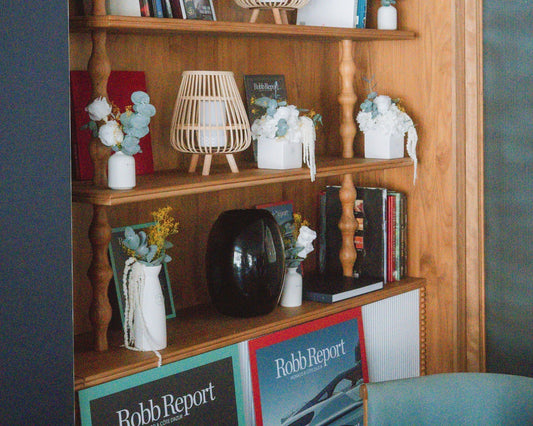
The brief was to give Kamoka a floral presence that reads as part of the interior, not placed on top of it, and holds its look whether she is at the dock in Antibes or three days into an Atlantic-facing passage.
One palette, worked at different scales

The programme runs on a single idea: a restrained white-and-green base, lifted by one warm accent carried through the boat. Get the through-line right once, and five arrangements read as one design.
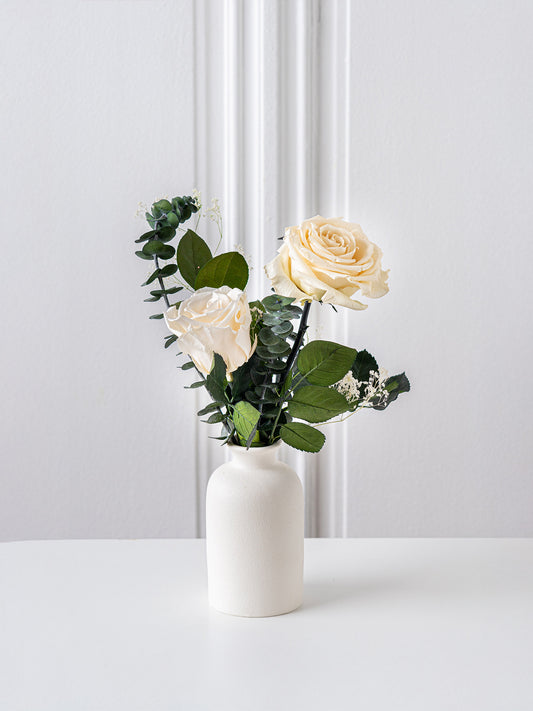
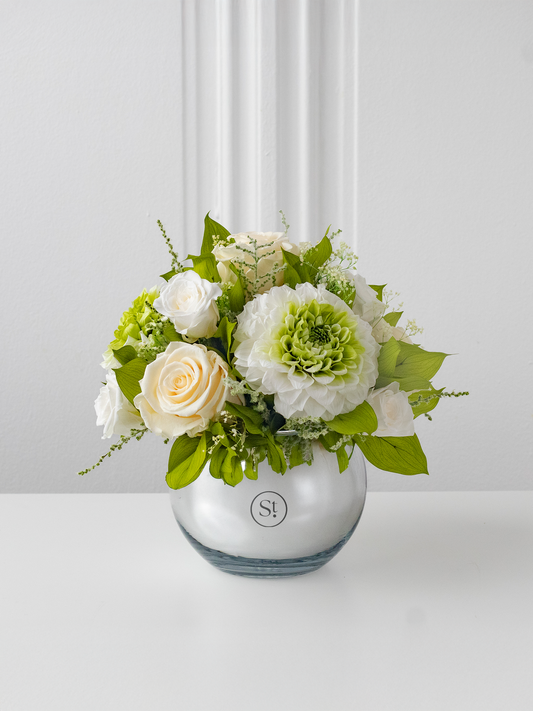
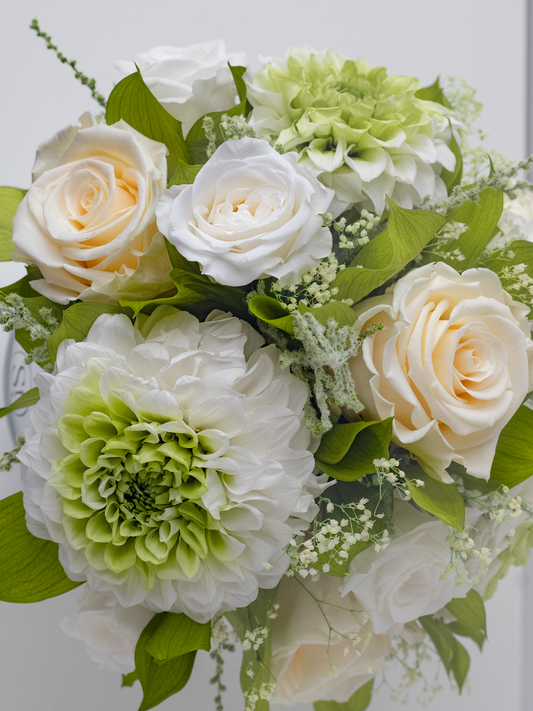
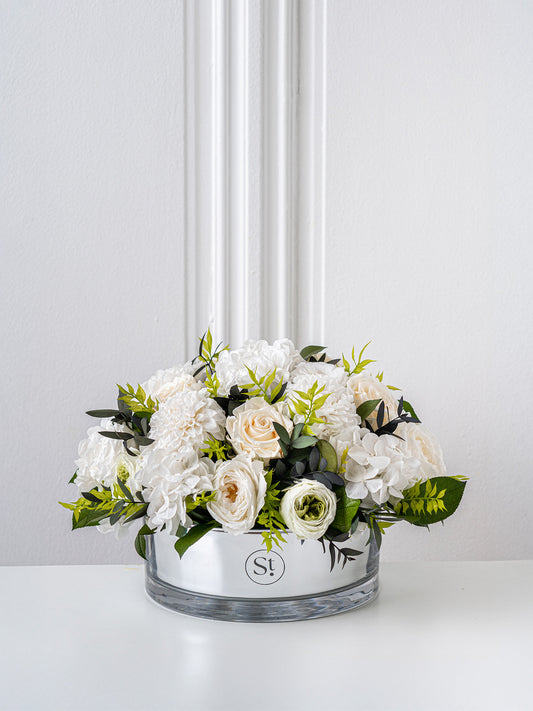
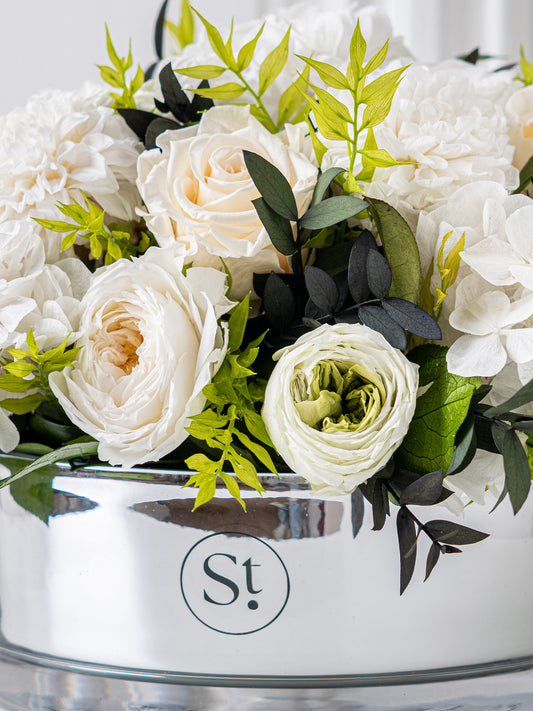
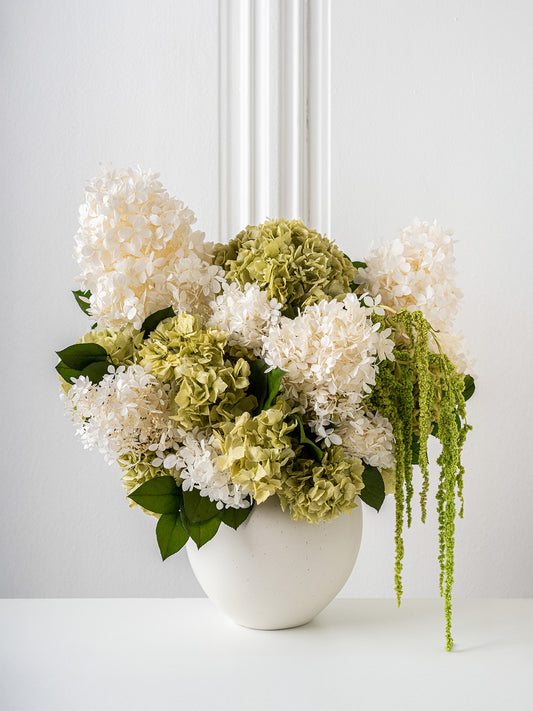
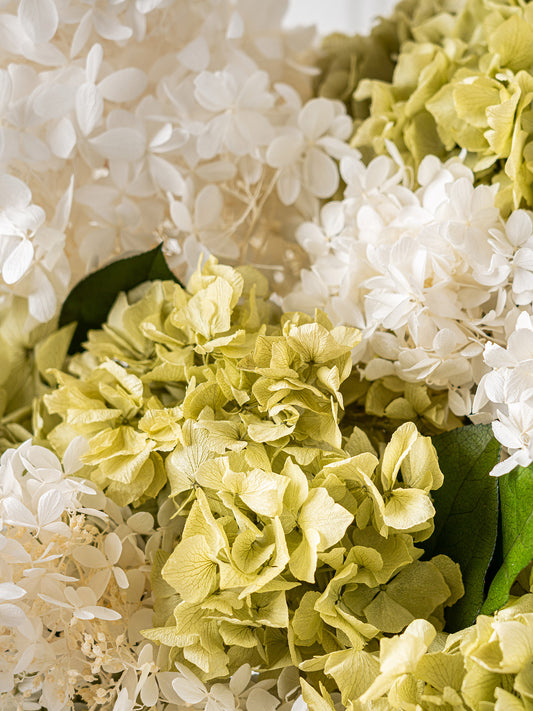
The base is preserved white and cream hydrangea, ivory and blush garden roses, ruffled lime carnations, and a green dahlia, all set into eucalyptus and fine willow-leaf foliage. The accent is preserved gypsophila in a burnt orange, and it is the decision that gives the programme its signature. Most preserved work for a yacht interior stays inside a safe band of blush and white. The orange is a deliberate break from that, warm enough to pick up afternoon light without pulling the whole scheme toward colour.
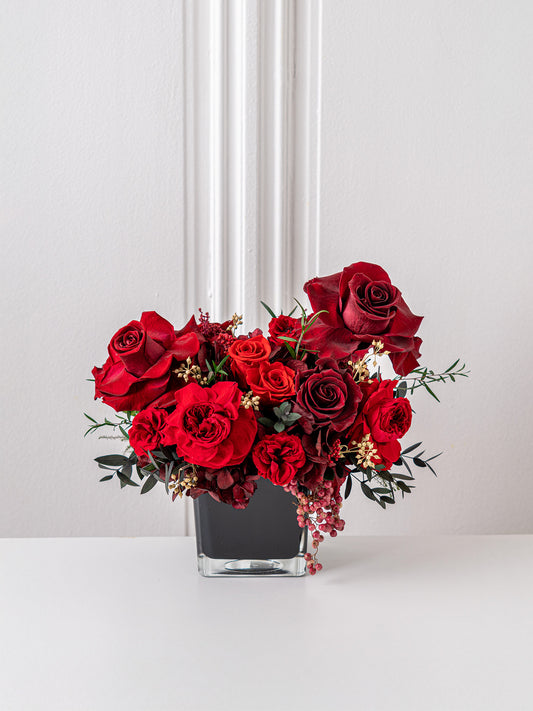
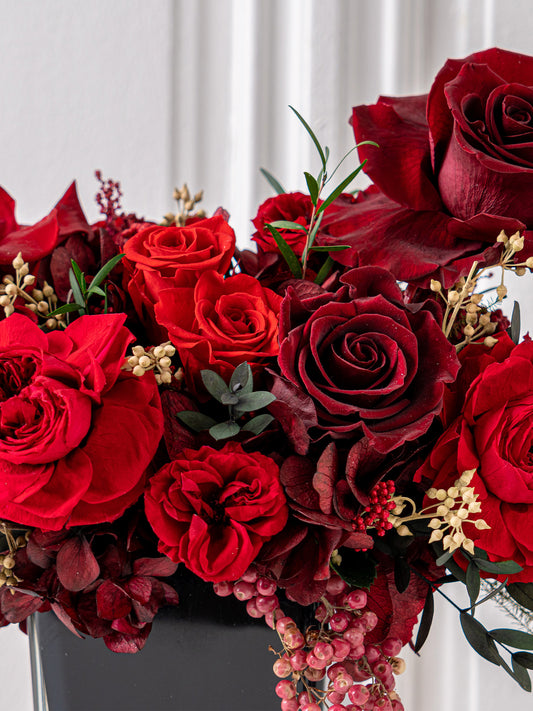
You can watch the accent move. In the two tall pedestal pieces, built into fluted white ceramic columns that echo the architecture of the interior, the orange comes in full, threaded right through the white hydrangea and cream roses so it reads from the far end of a room. In the low, wide bowl sized for a dining or coffee table, it is pulled almost entirely out, leaving a green-and-cream composition of white hydrangea against chartreuse, kept low so sightlines across the table stay open. A compact piece for a cabin or the study sits in a textured white cylinder, green ruscus and lime carnation around cream roses, the accent barely there. Then it returns, restated, in the boldest vessel of the set: a black-and-cream spotted glass cylinder, silver-dollar eucalyptus and tea-tree sprays breaking the silhouette wide.
Same palette, five volumes. That is the programme.
Why bio-preserved was the right medium for Kamoka
Preserved flowers are real flowers, arrested while still alive. They keep the surface and give of a living stem, which is why the roses still read as roses at close range. What they lose is the need for water, cold storage, and a weekly replacement cycle.
In the words of the interior crew: "We love the preserved flowers from STILLA. We have had them for 2 months and they still look and smell beautiful. They provided a detailed pitch for our yacht and executed it perfectly. Delivery and service exceptional. Thank you again".
On a moving boat, that is craft rather than convenience. A preserved programme holds its look for twelve months or more indoors, out of direct sun. There is no water to spill underway and nothing to keep cold in a galley fridge that has other jobs. The material travels, and it holds through a Mediterranean August and the humidity swings that come with a boat crossing between climates.
The sustainability case is grounded in the same facts. One arrangement standing for a year or more removes the constant cycle of cut stems flown in, refrigerated, displayed for a few days, and thrown out. The carbon argument for preserved flowers is strongest against imported fresh flowers specifically, which carry the cost of air freight and cold-chain storage before they ever reach a vase. It is not a blanket claim against all fresh floristry, and we do not make it as one.
When a Kamoka arrangement reaches the end of its life on board, it does not go to landfill. Through STILLA Purpose, refreshed pieces are donated to care homes and hospitals, which is where a year-old arrangement earns a second life rather than a bin.
What a full-boat preserved programme covers

For anyone weighing this for their own vessel, a STILLA yacht programme is more than a delivery of arrangements. It typically includes:
- A palette and design language set to the interior, so the florals read as one scheme across every space
- Bespoke arrangements scaled to each zone, from main-deck statement pieces to low table settings and cabin work
- Vessels chosen to sit with the interior's materials, whether ceramic, glass, or stone
- Bio-preserved botanicals rated to hold their look for twelve months or more, with no water or refrigeration
- End-of-life refresh and donation through STILLA Purpose
The result is a floral identity that behaves like the rest of a well-run interior. It is planned, it is consistent, and it stays put.
What fresh flowers actually cost the planet
Sustainability is usually where floral marketing goes vague, so here is the specific version.
The environmental cost of fresh cut flowers is concentrated in three places: air freight, heated greenhouses, and refrigeration. A life-cycle analysis by researcher Rebecca Swinn, comparing imported and locally grown flowers, put a typical imported mixed bouquet at around ten times the emissions of a locally grown one, with transport, heating and electricity as the main hotspots. Roses have drawn the most study; estimates for a single hothouse-grown stem land somewhere between 1.8 and 2.4 kg of CO2.
Preserved flowers do not erase that footprint. They change the maths by removing the repeat. The cost is paid once, at preservation, instead of every week for a year through fresh reorders, cold chain and replacement. On a vessel running a full season, that is the difference between one delivery and around fifty.
LEARN ABOUT OUR SUSTAINABILITY
When a STILLA piece reaches the end of its life aboard, it does not go in a bin. Through STILLA Purpose, arrangements are refreshed and given to care homes, hospitals and other facilities, so the flowers have a second life on land.
Frequently asked questions
How long do luxury preserved flowers last? Twelve months or more when kept indoors and out of direct sunlight. Many pieces hold well beyond that. On Kamoka, the programme is built to carry a full season and then some.
Do preserved flowers need water? No. They are real flowers preserved while alive, so they need no water, no feeding, and no cold storage. That is much of why they suit a yacht, where both space and weight are planned for.
Are preserved flowers real, or are they artificial? Real. Preserved flowers are grown, cut, and then preserved at their peak, which is different from silk or plastic. Up close they keep the texture of a living stem.
Are preserved flowers a sustainable choice? They can be. A single arrangement that lasts a year replaces dozens of fresh deliveries and the air freight, refrigeration, and waste that come with imported cut flowers. STILLA also donates refreshed pieces through STILLA Purpose rather than discarding them.
Can preserved flowers handle a yacht environment? Yes. With no water to spill and no need for a fridge, they travel well and hold their look through heat, humidity, and long passages, which is exactly what the Kamoka programme was designed for.
The Kamoka programme
Five arrangements, one palette, built to stay. Kamoka now carries a floral presence that matches the way she is run, present in every space and demanding nothing from a crew already managing a full boat.
We work with owners, captains, and chief stewardesses on programmes like this across the fleet. If you are planning florals for a new build, a refit, or an owner's arrival.
Start the conversation with La Maison STILLA.
Tags:
Previous
Preserved Flowers Donated to Palm Gardens of Aventura | STILLA Purpose
Next
STILLA Brings Eco-Friendly Preserved Floral Luxury to The Biltmore Hotel
Related articles


STILLA at the Palm Beach International Boat Show 2026 — A Week on the Ground
Post Date:
Apr 07, 2026